
Published: 1 February 2026 | Source: Press Information Bureau, Government of India
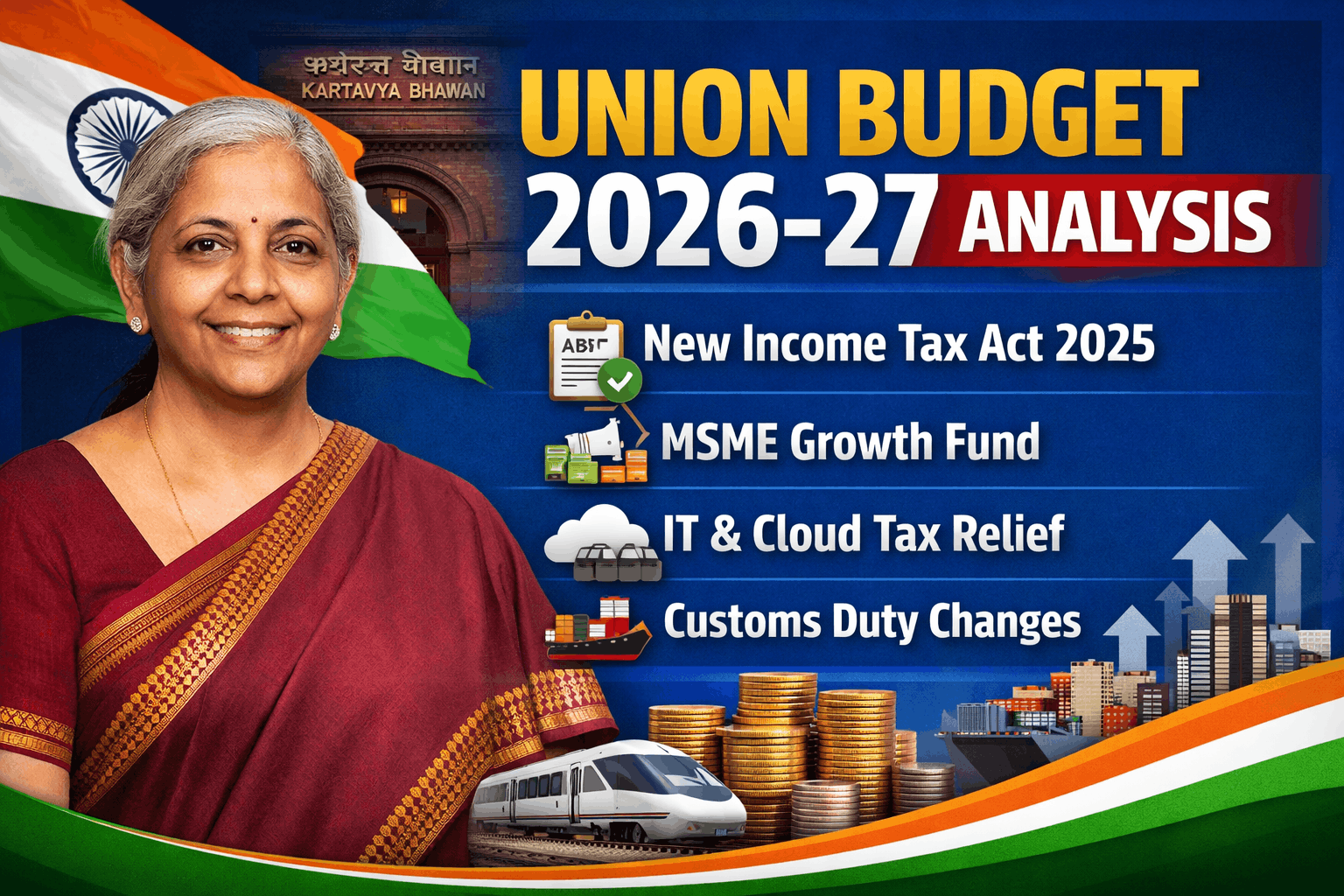
The Union Budget 2026–27, presented in Parliament by Nirmala Sitharaman, is a structurally transformative budget that goes far beyond annual allocations. As per the official Press Information Bureau (PIB) release, this Budget is framed as a Yuva Shakti–driven Budget, anchored in governance reform, long-term economic resilience, and simplified taxation.
This is also the first Union Budget prepared in Kartavya Bhawan, inspired by three Kartavya (national duties) that define India’s medium-term policy direction.
The Three Kartavya That Shape Budget 2026–27
According to the PIB release, the Budget is guided by three foundational commitments:
1. Accelerate and Sustain Economic Growth
This focuses on:
-
Enhancing productivity and competitiveness
-
Building resilience to global volatility
-
Strengthening manufacturing, infrastructure, and energy security
2. Fulfil Aspirations and Build Capacity
The emphasis is on:
-
Human capital development
-
Education, skills, and employment
-
Making citizens active partners in growth
3. Sabka Sath, Sabka Vikas
This ensures:
-
Inclusive access to resources and opportunities
-
Focus on poor, underprivileged, and disadvantaged groups
-
Regional balance including Purvodaya States and North-East
Together, these Kartavya signal a shift from scheme-based governance to capacity-based nation building.
Macroeconomic Context Highlighted by the Government
The Finance Minister, as per PIB, acknowledged:
-
Disruptions in global trade and supply chains
-
Increasing demand for critical minerals, water, and energy
-
Rapid technological transformation of production systems
Despite these challenges, India continues to take confident steps toward Viksit Bharat, balancing global integration with domestic resilience.
Over 350 structural reforms have already been implemented following the Prime Minister’s 2025 Independence Day announcement, including:
-
GST simplification
-
Labour Codes notification
-
Rationalisation of Quality Control Orders
-
Deregulation and compliance reduction with State Governments
PART A: Growth Strategy and Sectoral Interventions
Manufacturing and Strategic Sectors
Under the first Kartavya, the Budget proposes targeted interventions in six major areas:
-
Scaling manufacturing in 7 strategic and frontier sectors
-
Rejuvenating legacy industrial sectors
-
Creating “Champion MSMEs”
-
Infrastructure expansion
-
Long-term energy security
-
Development of City Economic Regions
Biopharma SHAKTI: Making India a Global Biologics Hub
A major announcement is Biopharma SHAKTI, with an outlay of ₹10,000 crore over five years.
Key components include:
-
Establishment of 3 new NIPERs and upgradation of 7 existing NIPERs
-
Network of 1,000+ accredited clinical trial sites
-
Strengthening of CDSCO through a scientific review cadre
This positions India as a global manufacturing and R&D hub for biologics and biosimilars.
Textile Sector: Integrated Employment-Driven Programme
The labour-intensive textile sector will be supported through a five-part integrated programme:
-
National Fibre Scheme
-
Textile Expansion and Employment Scheme
-
National Handloom and Handicraft Programme
-
Tex-Eco Initiative for sustainable textiles
-
Samarth 2.0 for skilling and modernisation
The focus is on self-reliance, exports, and employment generation.
MSMEs: From Small Businesses to Future Champions
Recognising MSMEs as the backbone of the economy, the Budget proposes a ₹10,000 crore SME Growth Fund.
This fund will:
-
Identify high-potential MSMEs
-
Incentivise scale, innovation, and formalisation
-
Support their transition into globally competitive enterprises
Infrastructure Push: Capital Expenditure Expansion
Public capital expenditure has increased dramatically:
-
₹2 lakh crore in FY 2014-15
-
₹11.2 lakh crore in BE 2025-26
-
₹12.2 lakh crore in FY 2026-27
Major initiatives include:
-
Dedicated Freight Corridors
-
20 new National Waterways
-
City Economic Regions with ₹5,000 crore per region
-
Seven High-Speed Rail Growth Corridors
Infrastructure remains the primary engine of economic multiplier effects.
PART B: Direct Tax Reforms Explained
New Income Tax Act, 2025 (Effective April 2026)
The PIB confirms that the New Income Tax Act, 2025 will come into force from April 2026.
Key objectives:
-
Simplified law and structure
-
Redesigned, easy-to-understand tax forms
-
Reduced litigation and interpretational disputes
-
Improved compliance for ordinary taxpayers
Relief Measures for Taxpayers
Significant reforms include:
-
Reduction in TCS on overseas tour packages to 2%
-
TCS on education and medical remittances under LRS reduced to 2%
-
Extension of return revision timeline till 31 March
-
Automated lower or nil TDS certificate system
-
One-time foreign asset disclosure scheme for small disclosures
Rationalisation of Penalty and Prosecution
The Budget proposes:
-
Integration of assessment and penalty proceedings
-
Reduction of pre-deposit for appeals from 20% to 10%
-
Immunity from prosecution extended to misreporting cases
-
Decriminalisation of procedural defaults
-
Retrospective immunity for minor foreign asset non-disclosures
This marks a decisive move toward non-adversarial tax administration.
Cooperatives and Agricultural Support
Deductions extended to cooperative societies supplying:
-
Cattle feed
-
Cotton seed
Additional benefits include:
-
Dividend deduction for inter-cooperative distributions
-
Three-year dividend exemption for notified national cooperative federations
IT Sector and Transfer Pricing Stability
All IT-related services are now grouped under one category with:
-
Safe harbour margin of 15.5%
-
Threshold raised to ₹2,000 crore
-
Five-year continuity once opted
-
Automated approvals and faster APA processes
This delivers unprecedented certainty to India’s IT exporters.
Attracting Global Business and Talent
Major global-facing reforms include:
-
Tax holiday till 2047 for foreign cloud service providers using Indian data centres
-
MAT exemption for non-residents on presumptive taxation
-
Five-year global income exemption for non-resident experts
-
Safe harbour for bonded warehousing at 2% margin
India is clearly positioning itself as a long-term global investment destination.
Indirect Taxes and Customs Reforms
Customs Duty Rationalisation
-
Exemptions for lithium-ion cells, critical minerals, aviation components
-
Customs duty on personal imports reduced from 20% to 10%
-
Basic customs duty exemption on 17 drugs and medicines
Trade Facilitation
-
Single digital window for cargo clearances
-
AI-based risk assessment
-
Removal of courier export value cap
-
Operator-centric customs warehousing
These reforms significantly enhance ease of doing business and export competitiveness.
Fiscal Consolidation Snapshot (As per PIB)
-
Fiscal Deficit FY 2026-27: 4.3% of GDP
-
Debt-to-GDP ratio: 55.6%
-
Net tax receipts: ₹28.7 lakh crore
-
Gross market borrowings: ₹17.2 lakh crore
The Government remains firmly committed to fiscal discipline.
Conclusion: Why Budget 2026–27 Is Structurally Important
As per the official PIB release, Union Budget 2026–27 is not a populist exercise. It is a structural, reform-oriented Budget aimed at:
-
Simplifying taxation
-
Reducing disputes
-
Strengthening infrastructure
-
Building human capital
-
Attracting global investment
For taxpayers and businesses, this Budget rewards compliance, transparency, and long-term planning.
About TaxProClarity
At TaxProClarity, we help individuals, MSMEs, NRIs, and enterprises interpret and implement Budget changes correctly, ensuring full compliance under the New Income Tax Act, 2025 and related laws.